|
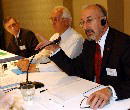
GLOBAL: Against the backdrop of China's tremendous growth in the auto sector, with new TNC investments announced regularly, more than 200 trade unionists from 25 countries are meeting in Dearborn, Michigan, USA, on June 8-10.
In his opening address to the conference, Ron Gettelfinger, president of the United Auto Workers (UAW) and the IMF Auto Department, dealt at length with China.
"We recognise that the denial of workers' rights in China threatens workers in every country. All of us must now compete against the painfully low wages and abysmal working conditions endured by so many Chinese workers."
As earlier reported on the IMF website, the UAW joined the AFL-CIO � the US national labour federation � in a petition against the Chinese government under the terms of US trade law, calling for sanctions against China for its illegal repression of workers' rights.
"If the petition had succeeded, the result would have been an increase in Chinese wages, which would benefit workers, families and communities in China � and the rest of us us as well," Gettelfinger said. "Imagine, for a moment, the potential purchasing power of one billion Chinese if they had the right to join unions and bargain for a better standard of living. Imagine the stimulus this additional purchasing power could deliver to the world economy. President Bush, unfortunately, has little interest in raising the living standards of Chinese workers. He rejected the AFL-CIO petition without any investigation."
Gettelfinger stressed that the IMF has its own vision of how the global economy can meet the needs of working families. One of the main tools is International Framework Agreements, IFAs, which require companies to recognise the core labour standards of the ILO in all of their global operations, and to provide decent pay and safe working conditions.
J�rgen Peters, the IMF president, said that "this unique development in the history of the auto industry, which has occurred at lightening speed, leaves us faced with a series of complex challenges. The biggest risk from the economic standpoint is that the corporate groups will rush like lemmings into the trap of overcapacity."
Referring to trade union challenges and response, Peters said that the Chinese official state-controlled unions have, up to now, neglected to fight for the introduction and implementation of internationally recognised workers' and trade union rights.
"They have even gone as far as to actively support denial of these rights. But, unless I am mistaken, there are now some initial signs of a cautious thaw. I am very much in favour of the IMF really getting to grips with the subject of China and its economic, democratic and trade union development."
Peters than made reference to and welcomed the recent IMF Executive Committee decision to set up a working group on China to assess the issue in depth and propose action.
Peters reminded delegates that the previous World Auto Council meeting, in Wolfsburg, Germany, January 2000, agreed to conclude IFAs with the auto companies.
"We have come a little closer to achieving these goals over the last four years. We have at least been able to get four international framework agreements signed. There is still a lot that remains to be done. But we have got off to a very promising start."
Presentations and panel discussions covered such issues as "Trade liberalisation and automotive industry restructuring" and "Trade union tools for a globalising automotive industry".
The World Auto Council closed with the adoption of conclusions calling upon the IMF and its affiliates to strenghten industry-wide capacities to respond to the challenges facing the trade unions.
For additional information, including links to speeches and publications, please consult the World Auto Council resource page.
|